Daily life
Italian Language Courses in Italy: Types, Costs and How to Choose (2026)
By Alessandro MichelizziFacts checked October 24, 2026
The short answer
Italian courses in Italy come from universities for foreigners, university language centers, free public CPIA schools for foreign residents, and private schools. As of October 2026, a 4-week course at the University for Foreigners of Perugia costs €540, and a month in Siena costs €570. A course longer than 90 days needs a national study visa, and the New York, Houston, Chicago and Los Angeles consulates do not accept a beginner course for one.
- Main types
- Universities for foreigners, university language centers, CPIA public schools, private schools
- Perugia (University for Foreigners)
- €540 per 4-week course, 18 hours a week at levels A1 to B2
- Siena (University for Foreigners)
- €570 a month (80 hours) through December 2026; €610 from January 2027
- Free option
- CPIA public courses for adult foreign residents, to at least A2
- Courses over 90 days
- National study visa; New York and Houston ask for B1 first and a course of at least B2
- Quality checks for private schools
- ASILS membership; exam center for CILS, CELI, CERT.IT or PLIDA
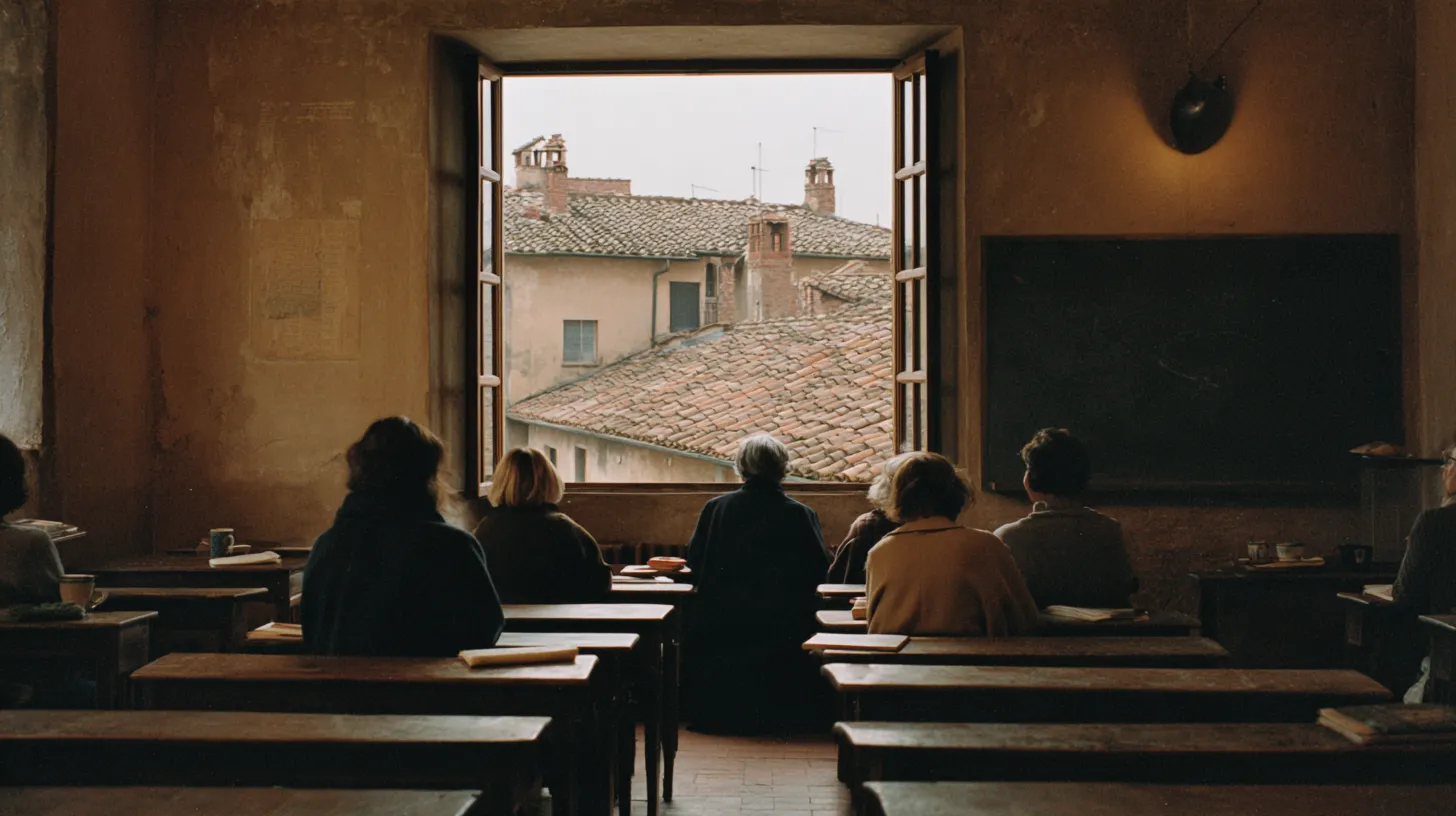
What kinds of Italian course exist in Italy
Five formats cover most options for adults. They differ in cost, pace and what they do for a visa.
- Universities for foreigners in Perugia and Siena run year-round courses at every level, in monthly blocks.
- University language centers at other universities run terms or short courses, some open to the public.
- CPIA (Centri provinciali per l'istruzione degli adulti, provincial adult education centers) teach Italian free to adult foreign residents.
- Private language schools set their own formats, class sizes and prices.
- Immersion formats add housing, a host family or cultural activities to the classes.
For what each level means in daily life, and how to start before you move, see the guide to learning Italian.
Universities for foreigners: Perugia and Siena
Università per Stranieri di Perugia (University for Foreigners of Perugia). Courses last at least 4 weeks. Lessons run 50 minutes, Monday to Friday, 2 to 4 hours a day. Levels A1 to B2 total 18 hours a week.
Each level from A2 to C2 takes 3 months, starting in January, April, July or October. You can also enroll for single months at any time of year. A1 is a 2-month course through December 2026 and becomes a 3-month course in January 2027. A 3-month A1 pilot also started in July and October 2026.
Before you start, you take an online written placement test by the 20th of the previous month, then an oral test on day one. You need 70% attendance to sit the monthly and final exams. A full level plus its final exam earns the university's Diploma of Proficiency in the Italian Language. At C1 and C2, you also need two culture courses.
Università per Stranieri di Siena (University for Foreigners of Siena). Its language center runs "corsi ordinari" (standard courses) of 80 hours a month. A full level is a 3-month module of 240 hours, from January, April, July or October, but you can enroll by the month.
Attendance is compulsory: more than 16 hours of absence bars you from the final exam. Passing it earns 4 ECTS university credits per month. The fee covers the placement test, tutoring, tandem language exchange support and library access.
To enroll in Siena, send an ID copy, proof of the first payment and your high school diploma. The diploma must be translated into Italian, English, French or Spanish. The university asks for the documents 1 month before the course starts.
University language centers
Other universities teach Italian to foreigners through their own centers. Formats vary, so check the dates, the hours and whether outside students can enroll.
- University of Florence, Centro di Cultura per Stranieri (Center for Foreigners). It has run courses since 1907. Its 2026 winter, spring and autumn terms each combine 120 hours of language with 90 hours of culture. The summer course has 90 and 60 hours.
- Sapienza University of Rome, Centro Linguistico di Ateneo (university language center). Its A1 course from June 4, 2026 was open to outside participants as well as students and staff. It ran 40 hours online, two evenings a week.
Free public courses: CPIA
The CPIA are public schools. Their Italian courses for adult foreigners are free and lead to a certificate of at least A2. Working-age foreign adults can enroll, including people with qualifications from their home country.
Enrollment is yearly, and courses run within each center's assigned staff, so places can be limited. Find your nearest center on the Ministry of Education's Scuola in chiaro (school finder) site.
Perugia's university also ran free courses in spring 2026, funded by the Ministry of the Interior through an EU migration fund. They offered 80 hours at B1 or B2, with 15 places per level. They were open to non-EU residents of Umbria holding a permesso di soggiorno (residence permit).
Private language schools: how to judge one
Private schools vary widely. Two outside signals help you compare them.
ASILS membership. ASILS (Associazione delle scuole di italiano come lingua seconda) is the Association of Schools of Italian as a Second Language. It is a trade association founded in 1992. As of October 2026, its site lists 39 member schools in 25 cities. In May 2026 it made the UNI 11863 service standard for Italian schools a condition for new members. Existing members were inspected against it and face yearly audits.
ASILS says its member schools guarantee:
- teachers with a degree and experience teaching Italian to foreigners
- prices that state the number and length of lessons and any extra services
- a placement test and a maximum class size published in advance
- inspected accommodation, with the address and description sent before you leave
- a certificate of attendance or a course description at the end
These are the association's own standards. Use them as a checklist for any school, member or not.
A certification exam center. Italy's Foreign Ministry lists four certification bodies, grouped in the CLIQ association. They issue CILS (Siena), CELI (Perugia), CERT.IT (Roma Tre University) and PLIDA (Dante Alighieri Society). To host CILS exams, an organization applies in writing, and Siena reviews a quality questionnaire on classrooms and equipment before signing an agreement. CILS lists its exam centers by region on its site.
Immersion and homestay formats
Many schools sell classes with housing and activities. ASILS describes member schools offering excursions, cooking lessons and cultural courses, and says it inspects both lodgings and host families.
Universities offer simpler versions. Perugia rents a limited number of beds in shared double rooms with ADISU (Agency for the Right to University Study) for €220 a month, all inclusive. Beds are for students aged 18 to 27, booked one month at a time, and the payment is non-refundable. Florence's term fee includes its culture courses, and Siena's includes them from level B1 up.
What courses cost in 2026
Fees as each provider lists them on its own site.
| Provider | Format | Fee | As listed |
|---|---|---|---|
| University for Foreigners of Perugia | 4 weeks, 18 hours a week (A1 to B2) | €540 (€490 if paid by the 10th of the month before) | October 2026 |
| University for Foreigners of Siena | 1 month, 80 hours | €570 a month or €1,550 for 3 months through December 2026; €610 or €1,670 from January 2027 | October 2026 |
| University of Florence, Center for Foreigners | Term of 120 hours language plus 90 hours culture | €890 a term; summer course €720 | Fees page updated January 13, 2025 |
| Sapienza University of Rome, language center | A1, 40 hours online | €390 for outside participants | June 2026 course |
| CPIA public schools | Italian for adult foreigners, to at least A2 | Free | Eurydice, February 2026 |
Perugia charges €480 for C1 and C2 without the final exam and €620 with it. Siena's fees include a €16 revenue stamp and drop 10% from the fourth month.
Courses longer than 90 days: the study visa
According to the Italian consulate in Detroit, US citizens need no visa for short-stay study. The limit is 90 days in any 180-day period. Perugia's page says citizens of the countries on the Foreign Ministry's list can enroll on a tourist entry for stays under 90 days.
A longer course needs a national (type D) study visa from the consulate that covers your home state. Details are in the student visa guide. As of October 2026, four US consulates set a level or an hours floor for language courses on their study pages:
| Consulate | Your level before applying | Course rules |
|---|---|---|
| New York | B1 certificate, an interview, or both | Full-time, fixed length, at least B2 |
| Houston | B1, shown by a certificate | At least B2; classes of at least 20 hours a week |
| Chicago | Not stated as a level | Not beginner level; full-time, at least 20 hours a week; paid in full |
| Los Angeles | Not stated | No national study visas for low to mid-level language programs |
New York adds that courses run by the four certification bodies toward CLIQ quality certification are considered to satisfy these requirements. It cites a 2012 agreement with the Foreign Ministry. The page does not say whether this waives the B1 entry level, so ask the consulate before you pay.
Once in Italy, you apply for your permesso di soggiorno within 8 working days of entry. See the permesso di soggiorno guide.
Certificates: a course is not an exam
Finishing a course gives you the school's own attendance certificate or diploma. Siena states plainly that its course exams do not give you a CILS certificate. A recognized certificate comes from a separate exam run by one of the four certification bodies. The guide to Italian language certificates compares them.
Common problems and fixes
Planning a long stay around a beginner course. Four US consulates rule out beginner or low-level language courses for a national visa. Fix: reach B1 before you apply and sit a B1 exam in the US, or keep your course to 90 days. The Italian Cultural Institute in New York, for example, is a CILS exam center.
Unclear level rules for your consulate. Applicants for language-course visas often post that they cannot tell which level their own consulate expects. Fix: read your consulate's study page, not another office's, and email its visa office if your district's page is silent.
Weekly hours below the consulate's floor. Perugia lists 18 hours a week of 50-minute lessons for A1 to B2, and 21 or 22 for C1 and C2 with the final exam. Houston and Chicago ask for at least 20. Fix: ask the school to state weekly hours in its letter, and confirm with your consulate before paying.
Fees you cannot get back. Florence's center says its fees are not refundable for any reason. Sapienza's language center gives no refunds, only a transfer to another course before the start. Fix: read the refund policy before paying, especially if your visa is still pending.
Do you need help with this?
Most people can choose and book a course on their own, especially for stays under 90 days. It gets harder when the course is the basis for a long-stay visa. Then the school's letter has to match your consulate's level and hour rules.
Frequently asked questions
How much does an Italian language course in Italy cost?
As listed in October 2026, the University for Foreigners of Perugia charges €540 for a 4-week course at levels A1 to B2, and the University for Foreigners of Siena charges €570 a month, rising to €610 from January 2027. The University of Florence's center charges €890 for a term of 120 hours of language and 90 of culture. CPIA public courses for adult foreign residents are free.
Can I take an Italian course in Italy without a visa?
Yes, for up to 90 days in any 180-day period if you are a US citizen. The Italian consulate in Detroit lists short-stay study among the purposes that need no visa for US citizens, and the University for Foreigners of Perugia enrolls students on a tourist entry for stays under 90 days. A longer course needs a national study visa.
Do I need to speak Italian to get a study visa for a language school?
At several US consulates, yes. New York and Houston ask for B1 before you apply and a course of at least B2. Chicago rules out beginner courses, and Los Angeles does not issue national study visas for low to mid-level language programs. Check your own consulate's page.
Are Italian classes free in Italy?
Yes, at the CPIA, Italy's public adult education centers. Their Italian courses for working-age foreign adults are free and lead to a certificate of at least A2. Enrollment is yearly and places depend on each center's staff.
How do I know if a private Italian language school is reliable?
Check whether it belongs to ASILS, a trade association that requires new members to meet the UNI 11863 service standard and audits existing ones yearly, and whether it is an exam center for CILS, CELI, CERT.IT or PLIDA. Then check that its prices state the number and length of lessons, the class size limit and the refund policy.
Related guides
mySoggiorno
Planning a move, not just a trip?
We handle your move, from legal counsel to your home and arrival, as one engagement. The fit check tells you in about three minutes whether a visa fits your situation.
Check your fit →3 minutes · free · a call if it fitsSources
- Normattiva: Legislative Decree 286/1998, art. 5 (residence permit application within 8 working days)
- Normattiva: DPR 263/2012, art. 4 (adult education courses)
- Ministry of Education and Merit: Enrolling in adult education courses
- Ministry of Education and Merit: Provincial adult education centers (CPIA)
- Ministry of Foreign Affairs: Language certifications
- Consulate General of Italy in New York: Study visa
- Consulate General of Italy in Houston: Study visa
- Consulate General of Italy in Chicago: Study visa
- Consulate General of Italy in Los Angeles: National visa for study
- Consulate of Italy in Detroit: Visas
- Consulate General of Italy in New York: Certification authorities (2026)
- Eurydice (European Commission): Italy, adult education and training (updated February 9, 2026)
- University for Foreigners of Perugia: Fees for Italian language and culture courses
- University for Foreigners of Perugia: Italian language courses
- University for Foreigners of Perugia: Structure of Italian language and culture courses
- University for Foreigners of Perugia: Academic calendar of language courses
- University for Foreigners of Perugia: Visa and residence permit
- University for Foreigners of Perugia: Accommodations
- University for Foreigners of Perugia: Free courses for third-country nationals (CIC to CIC 3 project)
- University for Foreigners of Siena, CLUSS: Corsi ordinari di lingua italiana
- University for Foreigners of Siena: Enrollment form 2026
- University for Foreigners of Siena, CILS: How to become an exam center
- University for Foreigners of Siena, CILS: Exam centers in Italy
- University of Florence, Centro di Cultura per Stranieri: Fees
- University of Florence, Centro di Cultura per Stranieri: 2026 course calendar
- University of Florence, Centro di Cultura per Stranieri: History of the center
- Sapienza University of Rome, CLA: Italian A1 course, June 2026
- ASILS: Home page
- ASILS: Guarantees
- ASILS: About the association
- ASILS: UNI 11863 standard presented in Rome (May 26, 2026)
Rules and office practices change. Every fact in this guide was checked against the sources above on October 24, 2026. This guide is general information, not legal or tax advice.